 Saturday, at 6:30 AM Joe, Molly, Daniel, Victor, Jennifer and I left for East Pokot. Before leaving town we picked up Theresa, a pastor who sold her home in the US and moved to Nakuru in December.
We went to East Pokot to visit Pastor Chochoi and his wife, Nelly, who operate a home for 50 girls. Many of the tribes in Kenya do female circumcision/mutilization and forced marriages. Often girls 15 years old (or younger) are forced to marry 50 or 60 year old men. They are essentially sold for a dowry. The Cana Girls Rescue Home takes in girls some as young as 8 or 9 who have run away to escape these horrid customs.
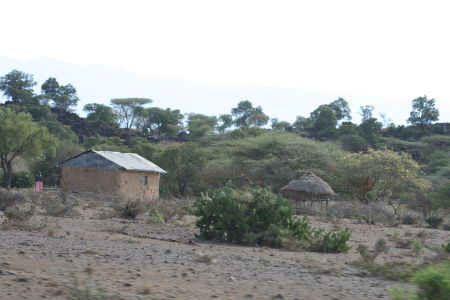
East Pokot is about 100 miles north of Nakuru. The drive started on a rough, paved-but-potholed road and after we crossed the equator it went down hill from there. The last 30-40 miles there was no pavement, no gravel, just dirt and rocks. The climate and vegetation also got more rugged as we traveled north, from a fairly temperate climate here in Nakuru to semi-arid and then arid. The East Pokot area is desert, similar to what you’d find in Arizona. The area is so dry, they can’t grow any crops.
The Pokots (the tribe of that region) survive by raising goats and honey, which they sell to get the grain and other things they need to (hopefully) survive. All along the drive to East Pokot there are dukas (little roadside stands) selling honey.
East Pokot is by far the most desolate and remote place I’ve ever been.
Cana Girls Rescue Home
Upon arriving, Pastor Chochoi invited us into his home for chai (tea) and chapate (flat bread). He described the circumstances may of the girls ran away from and how they were not only providing a home for these girls but school and a spiritual foundation so that the girls can learn a trade or go on to college and eventually become productive members of society and roll models for other girls.
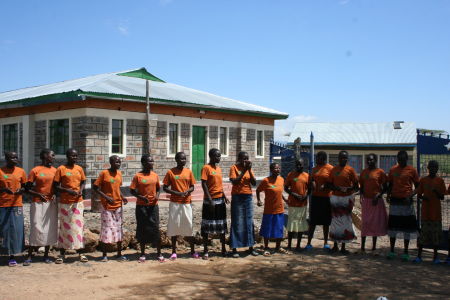 He showed us around the facility. They building is nice by Kenyan standards but they still don’t have tables and chairs in what will become the dining area, and they have empty rooms where they hope to house more girls, but just don’t have any beds for them yet.
We had a chance to meet some of the girls. They sang for us. Jennifer led them in making salvation bracelets and presented the good news of Jesus Christ using the colors as she did in Kabarak a few days earlier. Joe and Theresa spoke words of encouragement to them. Then we showed them some of the things we brought with us for them. We brought with us 10 cases of dehydrated food, which came at the perfect time as they were almost out of food. We also brought some toiletry items, feminine products, and lotions which brought big smiles to their faces. And we gave them a couple of soccer balls, which they were really excited about.
Elusive Camels and Downtown East Pokot
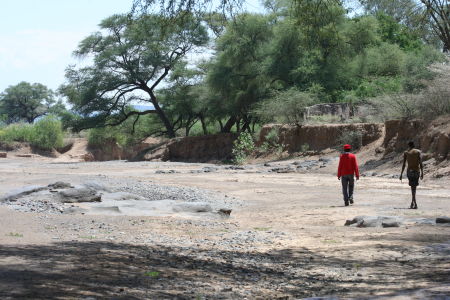 Pastor Chochoi then took us for a walk down to the river so we could see the wild camels that congregate there to drink. But all we saw was a dry riverbed and no camels. We continued to walk and walk and walk in extremely hot and dry conditions, but we never did see camels.
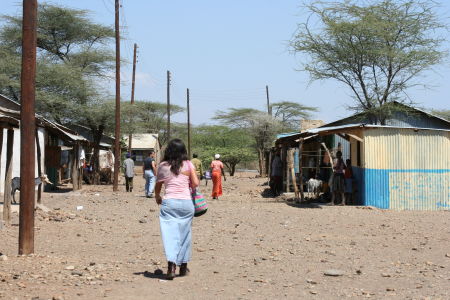
We eventually returned by going through what passes for downtown in a Pokot village. It was quite fascinating. We got to see some of the other people from the village including some of the older women who wear these beautiful bead neck rings and lots of earrings. We interacted with some of the children. Pastor Chochoi bought us all sodas from the shack, which serves as the supermarket for East Pokot.
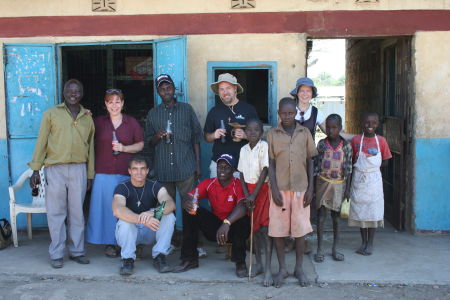
Food Distribution
We returned to Pastor Chochoi’s home where we were served a very nice lunch, though it’s going to take a while before I’m used to eating chicken chopped into chunks, bones and all.
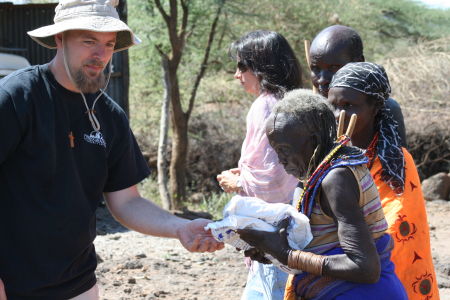 Before leaving we distributed dehydrated food to some the people of the village. I felt bad for them as they lined up to receive the food. I don’t know how they felt about it, and I’m trying not to project my feelings onto them, but if I was in their shoes I would have felt embarrassed and somewhat humiliated to line up with my hand out like that. We tried to preserve their dignity as best we could by smiling and saying “God bless you.” They don’t speak English, so I can only hope they know it was given out of love and genuine concern for them.
They we left on the long, hot, bumpy journey home. We had some car trouble and ended up stopped along side the road for a while, but Daniel, Victor, and Joe were able to do what was needed to get moving again. Daniel used to be a truck driver, and because of the rough roads in Kenya you’ve got to be an amateur mechanic to drive a truck. I think we got home around 8 PM after a very tiring, but rewarding day.
Reflections
As I sit and reflect on our trip to East Pokot, it’s just hard to believe that people live in these dry, desolate conditions. I also can’t imagine what it must be like to be a young woman in a culture where they still practice female circumcision/mutilation and forced marriage.
While some people would suggest the Pokot people need to be educated to get them to stop their terrible treatment of women, I just don’t see how that could change things. These are customs that go back thousands of years. The Pokot men view women as property and as long as that is the case, they will continue to treat women however they want. The only hope for these people, for the women, lies in a complete change of worldview. Only when a person receives Christ as their savior, can they understand that God loves each and every person, and that everyone, including women, is a valuable, child of God.
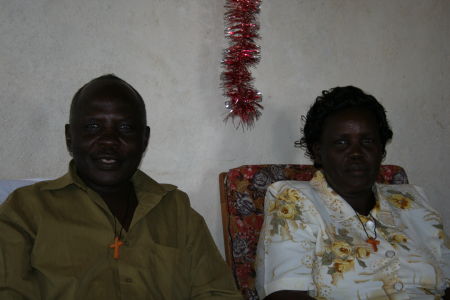 I’m amazed at the faith, the sacrifice, and the commitment of Pastor Chochoi and his wife. Pastor Chochoi is educated, speaks good English, and is gifted at networking and developing relationships. He could move somewhere else if he wanted too, somewhere less isolated and more comfortable. But he is Pokot and he has dedicated his life to serving the Pokot people and these young women.
Please pray for them as they do this very difficult work. Pray for the girls that after leaving their families they would know they are loved by God and the staff at the rescue home. Pray for Pastor Chochoi and Nelly that God would bless them and their ministry. And Pray for the people of East Pokot as they are in both a climatic and spiritual drought. Pray that God would provide the food and water they need to survive in an area that is already very dry to begin with but has received even less rain than usual And pray that the Pokot people would turn from their old ways and embrace Jesus as their savior and follow him with their lives.
Heading Home
Well, we are just about at the end of our trip. Sunday we begin the long trip back to the U.S. If all goes well we’ll touch down at TIA around 4:30 PM Monday. Please pray that we will have a safe and uneventful trip home. I’ll probably make one more post to wrap things up somewhere along the way or when we get home.
Day 7: Safari <– Kenya 2009 –> Post Trip: we’re Back!
Nice article. Well written. Unfortunately, I doubt whether you grasped the real problem of East Pokot. FGM is not an issue. The real issue is extreme poverty and illiteracy. Furthermore, this part of Kenya has been left behind deliberately as the country’s backyard.
If you could only match your words with action, you could mobilise resources that could help transform this impoverished society.
William, I suspect after a one day trip to East Pokot few people could fully grasp the problems of the area. But FGM is a horrid custom, a violation of basic human right, and an afront to God’s call for us to love one another. How can you say it’s not an issue?
We did see extreme poverty. As you can see from the pictures and descriptions above we distributed dehydrated food while we were there. We are not in a position to “mobilise resources that could help transform this impoverished society,” but we support Molly and Joe Bail who are working with Pastor Chochoi, serving the people of East Pokot.
What is your involvement in the area?
congratulation for your well written article.Surely you have gotten the real problem that is facing East Pokot.Imagine women are still counted as property in this advanced world of technology,FGM,hunger,illiteracy and other cultural practices that contributies negatively to the development of this region are still leading at a higher level.My prayer and my heart is in this loved community,to serve them wholeheartly despite the challenges we are facing.This is why I am persueing my studies at Pan Africa Christian University(BAB/T)with concentration in Mission in order to serve them effectively.Let pray for this community.Thanks God bless you all.Asante sana.
Great piece from Paul and another equally great from William. FGM is not a good practice, yes it ain’t, but among impoverished illiterates, it a normal practice. FGM is entangled in the complexities of positive modernization versus negative traditions; deeply routed ancestral practices versus unsustainable ‘imposed’ (read external) societal change; negative immediate rewarding practices versus positive long, and at times never rewarding practices.
In my opinion, actual transformation in East Pokot will not be achieved through armchair prescriptions but by embracing long-lasting practicable remedies which involves ‘matching words with action by mobilizing resources’ and ‘supporting Molly and Joe Bail who are working with Pastor Chochoi.
A long journey begins with a single step.
-Paul is a resident of East Pokot.
A historian who has written extensively on the ‘Pastoral Practices of Pokot from Naita to Malos’
Thanks for the good work and progressive efforts to help out with situation in East Pokot !!Well,it may seem they’re more problems than feasible solutions, but actually i think a step forward would to pray for basic education provision.
CANA project is practically the smartest idea, girls graduating from this will give back and contribute immensely in helping lift others up.I pray that you continue supporting this great man of God out there to rescue girls for demeaning practices.
I grew up in East Pokot before moving to the US for education.
blessings
My dear William and Paul, while I am extreamly thankful you had the opportunity to visit East Pokot and see the conditions of these forgotton people, I am saddened at what seems to be such a superficial grasp of a people in crisis. With the shortage of water, where would the people get the water necessary rehydrate the food you gave them. Feeling bad for someone who is so hungry that they have to accept food that is so foreign to them is not compassion. A bag of maize flour in Kitali is less than $3.00, and would have done a lot more good than unfamiliar dehydrated food. Were you with a Christian organization, was Pastor Chochoi a Christian Pastor? I am not trying to be rude, I am simply curious as to the God you serve. The God of the Christians, is a God who can effect change in any circumstance. The people I met in Kamanau, Koposes and Kokwokochigh were people who were eager for water-because they and their families and livestock were thirsty; the church-because with the church comes enlightenment and with enlightenment comes change and ease from harsh cultural traditions; and education-with education comes freedom from early marriage and FMC; these are the words of the people of the aforementioned places in East Pokot. Do not write off the people of East Pokot so easily, the first step on the road to change is the recognition of one person that a change is needed. Change will come to East Pokot. They are a forgotten people, forgotten by Kenya and the rest of the world, but God has not forgotten them.
PS The beautiful beaded neck rings are only given to girls who have been circumcised, the wooden neck ring is worn by uncircumcised girls.
Thanks Paula.
Well reading through your comment, i can detect a lot of passion in you, a lot of unexpressed emotions, emotions for someone who has this people in heart, emotions full of mercy, concern and yearn for change.
I agree with you in all this, and i support you in all your sentiments, east Pokot in the historical books i have been into is regarded as lawless jungle full of ignorance, and less populated a fact that i totally disputed because of the manner and lifestyles of the people of East Pokot who only entirely rely on God and their mights to survive in the vast “lawless land”
Change as you have strongly emphasized is coming and i can see light in your sentiments.For all this i wish to once agian Thank you for this golden and Godly Observation and Passion.
Thanks
Paula, thanks for your comment. To answer your questions, Pastor Chochoi is a Christian Pastor. I believe his ordination is through the Episcopal Church, but I could be wrong. He has lived in East Pokot for many years and his house is right next to the Canan Girls Rescue Home.
My understanding is that the dehydrated food we distributed is much better nutritionally than a simple bag of maize flower. Regardless, I trust that Pastor Chochoi understands what’s best for the people of his village.
It looks like the website for the Canan Girls Rescue home is down http://www.canarescue.org But if you are interested in helping the people of East Pokot, you can contact Rev. Theresa Webb (http://www.tjwebbministry.org/) who went with us, lives in Nakuru, and travels regularly to East Pokot to minister to the girls.
my name is kapoi born and brought up in east pokot and trained as a GIS specialist.
To my humble opinion, i think i am very much delighted by what i see there in east Pokot.And about Cana girls, i have many more praises to shower on the project.This is lifetime investment on Pokot people,i suggest that CANA to take a step higher by making itself a faith based NGO internationally recognized and start floating its proposals for funding and improvement of social and physical infrastructure within their area of operation.
Thanks i will chip in more comments once i get to know the your stand on this
Many thanks Paul for the script, well written and good for reading. Like many others before you, the myriad issues facing East Pokot communities isnt FGM as a priority; it is rather giving individuals/people the basic right to live by the power of knowledge and freedom from within themselves. With education, these girls could make their own decisions on a whole range of aspects – from reproductive health, lifestyle, leadership to marriage(including the choice of a partner that rately exists in old cultures. For me I wont be labouring much on FGM as the first priority, the route causes of these is marginalization, neglect and denial of some of the catalysis of human advancements. What Texans in America used to do in 1400s are similar, the denial of human suffering in some remote areas of Nepal by the Chinese is still the similar though not the same. In the mightest democrazy in America women, lesser races among others couldnt vote in USA till 60s, this is where the Nginyang and East pokot people are stuck thanks to successive governements their soloist Western goverments who glose their eyes on these things when dealing with our leaders!
I hope your team could do more advocacy in future especially with the pictures you have – something like ‘Bono’ type of advocay but this time bordering on neglect and marginalization
By the way I come from this place and currently working in Liberia
Good article. One dimension written; an external world view. Unfortunately, I come from the very area you are talking about my friend, the problem isn’t really the one you have just mentioned in the article, I doubt whether you grasped the real problem of East Pökot in 3 dimensions. FGM is not an issue. The real issue is the complexity of the culture blend with extreme poverty, illiteracy, leadership indifference, marginalization, lack of exposure. Surprisely this community has been deliberately left out compared to the rest part of Kenya. If you want to know more about east Pökot then study the cultural practices; shocking to you will see. Pökot image have been deliberately tainted and blocked from any kind of assistance or well-wishers.
FGM is not done in the community to harm those loved girls, if they fail to go through such horrid custom no one will marry them (within the community), unless they are educated, then they can articulate themselves in the community.
The place needs real transformation for people to realize their potentials and work toward their aspiration as one. If you could only match your words with action, you could be part of the few blessed to accompany this people realize their problems and engage in real transformation. Lobby and advocate them
Thanks Lotela,
I think FGM is a big issue, and i belief that E. Pokot at the moment has enough potential to grow without any foreign help.Meaningful change emanates from the people,and i feel there is a lots to be done to incorporate smart folks into leadership and decision making.The government spends over 50M on East Pokot only, imagine if half that amount was channeled to education and scholarships for girls ! Politics is life, you have bad politicians you lose big time, conversely smart and selfless decisions makers are the pith of meaningful transformation. We have the resources, we just need the skills to take us there !!
i thank all of you by supporting him”Pr. chochoi” is not everyone who can mean to start such institution for the benefit of us without any contribution therefore i urge the old man to keep on with that spirit and God will never leave him like that. Congratulation “ngusurin” we pray for you.
Thanks guys. the issue is very sensitive as far as humanity is concerned. I would like to say that those people living in and around the developing centers are a bit sensitized about the effects of FGM and they have changed as compared to those living in the interior part of the area, so the only thing that has to be done is to go further with the mission of making the people aware of the effects of the practice particularly those living in the interior part of our area. Thanks
We would like to initiate disaster and risk reduction based projects on livelihoods of people in East Pokot. We are an NGO already working in Western Kenya and parts of Rift Valley. We would like to know how we can work with the church on ground and with your organization. We are looking at promoting food security, water and sanitation projects here
Thank you
Hi Eunice! You are Welcomed.
Am not writing on behalf of the authorities you are seeking partnership with but on behalf of myself as a member of east Pokot and those who will feel part of me in this comment.Please you are welcomed as you know the place has history of droughts and other complexities, and the marginalization in it attention to responses from crisis there.The entry for you is free, but the care has to be taken so that you dont find yourself in a political mix of the place,resilience and respect to the course set for your responses is very important.Success and Welcome!
Hi Eunice, you can contact Pastor Chochoi and the Cana Girls Rescue Home through their website – http://www.canarescue.org/
Thank you for that I will go their website and get the contacts and proceed , Thank you Paul, Thank you Kapoi
Welcome Eunice, we shall be there to help you as well.
Hi Eunice, I have the contacts of Rev.Canon Chochoi,0721462055 kindly contact him he is in charge of CANA girlsplease make use of him
East Pokot is a place of forgotten people by the government and other stakeholders.Matters of FGM should have been seized out long time ago if proper education and awareness was conducted by the relevant authorities.Look at the state of roads,it is pathetic yet Baringo District was the home of the former president!He choose us to remain behind and leave us for God to decide.I appreciate those who are bringing change in this devastated region.(ERASTUS IS A STUDENT AT KENYATTA UNIVERSITY MAIN CAMPUS NAIROBI.)
Erastus, thanks for your comment. I hope that you will be one of those who brings change to East Pokot. Don’t just wait for government and other leaders to bring change. You can make a difference.
thanks paul for your advocacy on the issues surrounding the Pokot community living in the semi arid lands of East pokot.FGM is one of the sensitive issue but their are other major challanges like marginalization, illiteracy,food security and even insecurity that need to be addressed by all who have the hearth and will to assist. lets not waste time discussing on issues but let us work towards eradicating them.
Hi Francis
Thanks for the comment!
However, its time for us all to play part, Paul has done it through the way He best understood it, and through the way he discovered the best.it is through this way (paul’s way )that saw many of those girls see education, for the other themas you have mentioned, we are not always short of such, but if you can, me and you shall have to see the way to do or solicit for support, What Paul and Canon Chochoi has done is much far and burndsome, heavily criticized and full of resistance, which we all acknowledge beacuse of our cultural background and commomn resistance to change.
Thanks for your comment, John. It’s neat to see you come back and respond to comments like this.
How are you doing? How are things in Kenya right now? Are you making progress towards your dreams and goals?
Fancis, thanks for your comment. Discussing the issue brings attention to it as well as to people like Pastor Chochoi who are not only helping young girls escape FGM but providing them a place to live, food to eat, education and a spiritual foundation. Perhaps some who read this will provide financial support to Pastor Chochoi and the girls or even bring a team of people to serve with them.
With small steps comes bigger contributions, as I had indicated in my two years ago post, the Texans did still stands, FGM isnt an isolated issue and if it is treated like this, it wont go away, lots of papers have been written on best practises esp on a multiplistic approaches. Currently the situation in East Pokot is better than the time of this visit, now the KENYAN government has taken electricity/power, a 60Km tarmarc connecting NAKURU and Kollowa is ongoing, in addition,alot of water systems are under construction. FGM needs livelihood changes, not focusing on individual thematic like education alone, even though these are the building blocks. The Kenya Red Cross is undertaking 2 Major irrigation Projects at Modoo(Nginyang) and Kollowa worth over 3.5Million USD Dollors; and personally I think this will significally lead to less nomadism and less dependency on cows that is the biggest contributor to dowry and FGM…for those who want to think and hope big for East Pokot like me and others, the new Kenyan constitution offers a huge opportunity for new leadership and much innovations moreso at the household level…
Thanks for the update. It sounds like positive progress is being made.
This is a moving account of what goes on in East Pokot. The situation is not any better in 2012. The girls in Cana Girls Recue Center are now 76 and Pastor Chochoi and mama Nelly are are even more dedicated to their divine calling. They need not only prayers but also Financial Support. I felt them when they hosted me for two months in East Pokot.
Thanks for the update George. I had the opportunity to visit again last Summer with a group from my church:
http://cypressmeadows.org/blog/kenya/2011/07/14/day-8-cana-girls-rescue-home-in-east-pokot-kenya/
It seems like they are making progress – adding a garden, new latrines, better plumbing – but I imagine word continues to get out about the good things God is doing through Cana, more girls will go there for help.
Thanks paul for the well writen article, i suggest that you pay a visit to churo boarding primary and see how they have rescued girls from early marriages and educate them.
i would like to visit this area and preach the love of christ on 30th nov
i would like to visit this area and preach the love of Christ on 30th Nov
may good God bless the pastor and all who did this good job
i would like to visit this area and preach the love of Christ on 30th Nov
may good God bless the pastor and all who did this good job may they continu